
SEARCH PRODUCTS
OEM vs Aftermarket Wiper Linkage Assemblies: What Buyers Should Evaluate
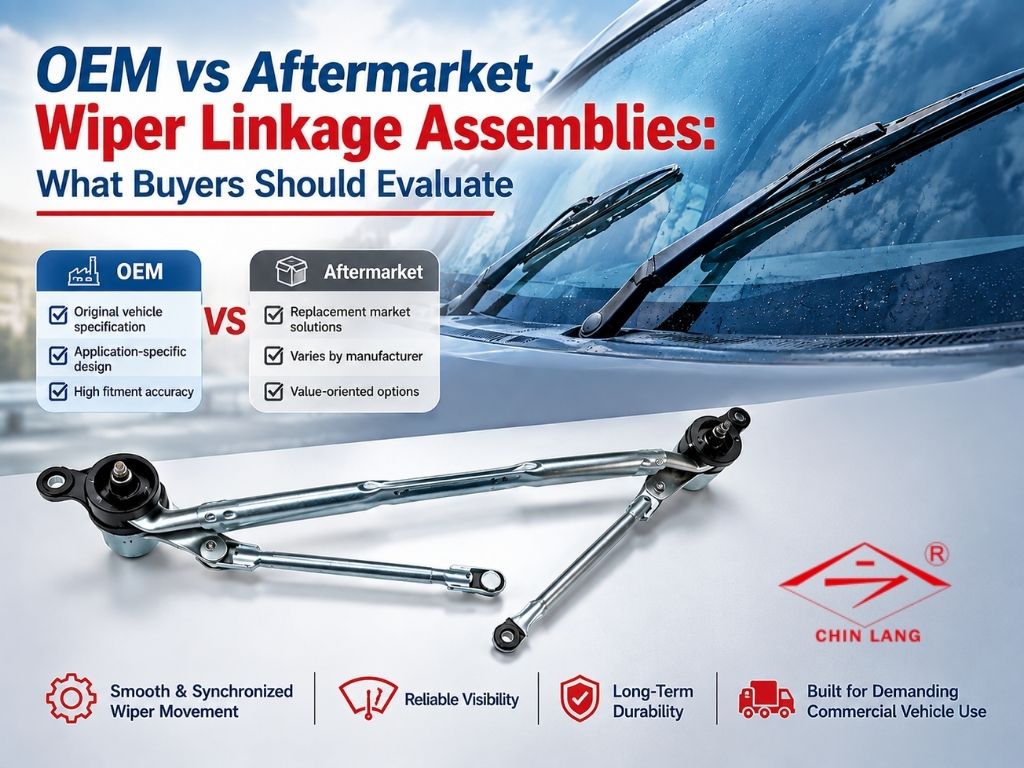
When sourcing a wiper linkage assembly, buyers often encounter two broad options: components supplied for original equipment applications and replacement products developed for the aftermarket. The distinction may sound straightforward, but choosing between OEM and aftermarket solutions involves much more than comparing a brand name or purchase price. Fitment, linkage geometry, material durability, manufacturing consistency, and application compatibility can all influence how the wiper system performs after installation.
For distributors, repair markets, fleet service providers, and vehicle component buyers, the more useful question is not simply whether OEM or aftermarket is better. Instead, buyers should evaluate whether a wiper linkage assembly can deliver the required motion, fit the intended vehicle application, and maintain dependable performance over its expected service life. With long-term experience manufacturing automotive wiper system components, Chin Lang Autoparts understands that reliable replacement solutions depend on matching the functional requirements of the vehicle rather than relying on category labels alone.
This guide explains the major differences buyers may encounter between OEM and aftermarket wiper linkage assemblies and the factors that should be evaluated before making a sourcing decision.
What Is an OEM Wiper Linkage Assembly?
An OEM wiper linkage assembly is designed for use in a specific vehicle platform according to the requirements established for original vehicle production. Its mounting locations, linkage dimensions, pivot positions, sweep geometry, and connection with the wiper motor are developed around that particular vehicle application.
This application-specific design is important because the linkage does more than physically connect the wiper motor and arms. It determines how rotational motor output is converted into the oscillating movement required to clear the windshield. Small differences in geometry can alter the sweep angle, parking position, synchronization, or mechanical load placed on the system.
OEM applications therefore establish an important reference point for fitment and functional performance. However, this does not mean that every replacement part must come directly from the original vehicle manufacturer. A properly developed aftermarket replacement can also be engineered around the relevant vehicle specifications and application requirements.
What Is an Aftermarket Wiper Linkage Assembly?
An aftermarket wiper linkage assembly is produced for replacement use after a vehicle has entered service. These products may be supplied by specialized automotive component manufacturers rather than through the original vehicle manufacturer's parts network.
The aftermarket covers a very broad range of quality levels. Some products are developed with careful attention to vehicle-specific dimensions, material selection, joint performance, and manufacturing consistency. Others may focus primarily on reducing cost, potentially resulting in greater variation in fitment or service life.
For buyers, this variation makes supplier evaluation particularly important. An aftermarket product should not be judged solely because it is classified as aftermarket. The more meaningful questions are whether it is designed for the correct vehicle application, whether critical dimensions are controlled, and whether the manufacturer can maintain consistent production quality.
1. Start with Vehicle Fitment and Application Compatibility
Fitment should be the first consideration when evaluating any replacement wiper linkage assembly. A component that looks similar to the original does not necessarily have the same operating geometry.
Buyers should verify the intended vehicle model, applicable production year or platform, mounting configuration, motor connection, pivot locations, and linkage dimensions. These details determine whether the assembly can be installed correctly and operate within the intended sweep range.
This is particularly important when sourcing parts for international aftermarket distribution. A vehicle nameplate may be used across several markets while individual specifications differ by model year, body configuration, or regional version.
Accurate product identification therefore reduces installation problems, returns, and customer complaints. For professional buyers managing multiple vehicle applications, clear cross-reference and application information can be just as important as the physical quality of the component itself.
2. Evaluate Linkage Geometry, Not Just External Appearance
Two wiper linkage assemblies can look nearly identical while producing different wiping behavior.
The length of each link, position of the pivots, crank geometry, and relationship between moving joints determine how motor rotation translates into wiper arm movement. These dimensions influence the wiping arc, synchronization between wiper arms, and final parking position.
If replacement geometry differs from the intended configuration, the system may still operate but produce problems such as insufficient windshield coverage, excessive sweep, incorrect parking position, or uneven movement.
For this reason, professional buyers should avoid treating a windshield wiper linkage as a generic metal assembly. Geometry is a functional specification. Accurate manufacturing and application-specific design are therefore essential when selecting either OEM or aftermarket products.
Related Reading: How Wiper Linkage Assembly Design Affects Wiping Precision and Synchronization
3. Compare Joint Quality and Long-Term Motion Stability
A wiper linkage assembly contains multiple moving connections that operate repeatedly whenever the windshield wipers are activated. These joints must allow smooth movement while controlling unwanted clearance.
As components wear, excessive play can develop around pivots and connection points. This may eventually contribute to inconsistent arm movement, increased mechanical noise, reduced synchronization, or unreliable wiping.
When comparing replacement options, buyers should therefore consider the quality and consistency of moving joints rather than focusing only on the visible metal structure. A linkage assembly intended for long-term service needs to maintain stable mechanical relationships through repeated operating cycles.
This becomes especially important in commercial vehicles or applications that experience frequent rain, high annual mileage, vibration, and extended service periods.
4. Consider Structural Strength and Material Durability
Windshield wiper linkages operate under changing mechanical loads. During normal rain, resistance may be relatively low. Under heavier rain, accumulated debris, strong airflow, or other demanding conditions, the motor and linkage can experience greater loads.
The structural components must therefore maintain sufficient rigidity to transfer motion without unwanted deformation. Material thickness, component geometry, forming quality, joint construction, and surface protection can all contribute to long-term performance.
Corrosion resistance also deserves attention because wiper linkages are commonly located beneath the windshield cowl, where moisture and environmental contaminants may be present. Progressive corrosion can weaken components or interfere with joint movement over time.
For buyers comparing OEM and aftermarket alternatives, material quality should therefore be evaluated together with structural design and manufacturing execution.
5. Check Wiper Motor and Linkage Compatibility
The wiper motor and linkage operate as one mechanical system. The motor provides rotational force, while the linkage converts that force into the movement of the wiper arms.
An incorrectly matched linkage may change the mechanical load experienced by the motor. Differences in lever ratios, pivot resistance, or linkage geometry can affect how efficiently torque is transmitted throughout the wiping cycle.
This is why replacing a linkage assembly should not be approached purely as a dimensional fitment exercise. Correct mechanical compatibility helps maintain smooth movement and reduces unnecessary stress on the rest of the wiper system.
For buyers, particularly those sourcing replacement components in volume, verifying the intended motor and vehicle application can help prevent problems that may not become obvious until after installation.
6. Manufacturing Consistency Matters for Both OEM and Aftermarket Parts
One of the most important considerations for B2B buyers is consistency.
A single sample may perform correctly, but distributors and automotive parts suppliers need the same level of fit and function across repeated production batches. Variations in link dimensions, pivot positions, assembly alignment, or joint condition can translate into inconsistent field performance.
This means buyers should evaluate the manufacturer's ability to control production, not merely inspect a finished sample. Dimensional control, assembly repeatability, quality inspection, and stable manufacturing processes are important regardless of whether a component is intended for an OEM or aftermarket program.
For aftermarket distributors in particular, consistency can directly affect return rates, customer satisfaction, inventory confidence, and the long-term reputation of their own product offering.
Related Reading: Custom Wiper Linkage Assembly Development for New Vehicle Platforms
7. Compare Total Value Instead of Purchase Price Alone
Price is naturally an important factor when sourcing high-volume automotive replacement parts, but the lowest unit price does not necessarily represent the lowest total cost.
A lower-priced linkage that creates fitment problems, premature joint wear, installation difficulty, or higher return rates can generate additional costs throughout the supply chain. Distributors may face warranty handling and inventory issues, while repair businesses may need to repeat installation work.
A more useful evaluation considers total value across several factors:
| Evaluation Factor | Why It Matters |
|---|---|
| Vehicle Fitment | Helps reduce installation problems and returns |
| Linkage Geometry | Supports correct sweep and synchronization |
| Joint Quality | Influences smooth operation and service life |
| Structural Durability | Supports performance under repeated mechanical loads |
| Corrosion Resistance | Helps maintain reliability in exposed environments |
| Manufacturing Consistency | Supports stable quality across production batches |
| Supplier Support | Helps buyers manage application and sourcing requirements |
OEM products may provide a strong application reference, while well-developed aftermarket products can offer an effective replacement solution when produced with appropriate engineering and manufacturing controls. The best sourcing decision therefore depends on the requirements of the buyer, vehicle application, target market, and expected quality level.
OEM vs Aftermarket Wiper Linkage Assemblies: A Practical Comparison
Rather than viewing OEM and aftermarket as simply "good versus bad," buyers can compare the two based on their sourcing objectives.
| Consideration | OEM | Aftermarket |
|---|---|---|
| Vehicle Application | Developed for original vehicle specification | Should be verified for the intended replacement application |
| Availability | Depends on original parts supply network | Can provide broader replacement-market sourcing options |
| Product Variation | Generally application-specific | Quality and specifications vary by manufacturer |
| Fitment | Based on original platform requirements | Depends heavily on product development and application accuracy |
| Buyer Evaluation | Confirm OE application and supply conditions | Evaluate fitment, quality consistency, and supplier capability |
| Best Suited For | Original equipment requirements and OE replacement channels | Replacement markets, distributors, and aftermarket programs |
The key point is that the quality of an aftermarket wiper linkage assembly depends heavily on the manufacturer behind it. Buyers should evaluate the actual product and supplier capabilities rather than making decisions based solely on the OEM or aftermarket label.
How Modern Vehicle Design Influences Wiper Linkage Selection
Vehicle architecture is also becoming an increasingly important consideration when sourcing wiper linkage assemblies. Larger windshields, tighter under-cowl packaging, aerodynamic body designs, electric vehicle platforms, and camera-based driver assistance systems can all influence wiping requirements.
For buyers involved in newer vehicle applications, evaluating a linkage therefore requires more than confirming that it physically fits. Sweep coverage, synchronization, packaging space, structural rigidity, and compatibility with the overall windshield system may all need to be considered.
This is particularly relevant as replacement markets expand to include newer vehicle generations with increasingly complex packaging and visibility requirements.
Related Reading: How Windshield Wiper Linkages Support Modern Vehicle Design Trends
Wiper Linkage Assemblies from Chin Lang Autoparts
Chin Lang Autoparts manufactures wiper linkage assemblies for a range of automotive applications, supporting customers in the replacement and automotive parts markets. Its wiper linkage product range includes vehicle-specific configurations designed to meet different installation and operating requirements.
For buyers sourcing replacement wiper linkage assemblies, application accuracy is especially important. Differences between vehicle platforms require appropriate linkage dimensions, mounting configurations, and mechanical layouts rather than a one-size-fits-all approach.
Through its experience in automotive component manufacturing, Chin Lang Autoparts focuses on providing dependable wiper linkage products with attention to fitment, structural durability, and consistent production quality. Buyers can review the available applications and discuss specific sourcing requirements based on their target vehicle or market needs.
What Should Buyers Ask a Wiper Linkage Supplier?
Before selecting a supplier, buyers should have enough information to confirm both product compatibility and supply reliability. Rather than asking only for price, it is useful to confirm the exact vehicle application, relevant model or year information, product specifications, and whether the supplier can support consistent repeat orders.
For distributors managing a broad catalog, product identification support is particularly valuable. Correct application matching can reduce ordering errors and help ensure that customers receive the appropriate linkage assembly for the intended vehicle.
Buyers should also consider communication, manufacturing experience, quality consistency, and the supplier's ability to support long-term cooperation. These factors become increasingly important as order volumes and the number of vehicle applications grow.
FAQ: OEM and Aftermarket Wiper Linkage Assemblies
Is an OEM wiper linkage assembly always better than an aftermarket one?
Not necessarily. OEM components are developed around original vehicle specifications, but aftermarket quality varies significantly between manufacturers. A properly engineered aftermarket linkage can provide a dependable replacement when fitment, geometry, materials, and manufacturing quality are appropriately controlled.
Can the wrong wiper linkage fit but still cause wiping problems?
Yes. A linkage may physically mount to the vehicle while having differences in geometry that affect sweep angle, synchronization, or parking position. Correct application matching is therefore essential.
What should distributors check before ordering aftermarket wiper linkages?
Buyers should confirm vehicle application information, linkage configuration, mounting points, motor compatibility, manufacturing consistency, and supplier support.
Why does linkage geometry matter?
Linkage geometry determines how motor rotation is translated into wiper arm movement. Differences can change the wiping pattern, synchronization, and mechanical load within the system.
Is price the most important factor when sourcing replacement wiper linkages?
No. Unit price should be evaluated together with fitment accuracy, durability, consistency, return risk, and supplier reliability. These factors influence the actual total cost of sourcing and selling the product.
Choose Wiper Linkage Assemblies Based on Application and Reliability
The decision between OEM and aftermarket wiper linkage assemblies should not be based on labels alone. For professional buyers, the more important question is whether a product provides the correct fitment, geometry, durability, and manufacturing consistency for the intended vehicle application.
A reliable aftermarket solution can offer strong value when it is developed around accurate application requirements and supported by consistent manufacturing. Conversely, choosing a component based only on appearance or low price can increase the risk of installation issues, premature wear, and product returns.
Chin Lang Autoparts provides wiper linkage assemblies for various automotive applications and supports buyers seeking dependable replacement solutions. Contact Chin Lang Autoparts to discuss vehicle applications, product requirements, and wiper linkage sourcing opportunities.