
SEARCH PRODUCTS
Custom Wiper Linkage Assembly Development for New Vehicle Platforms
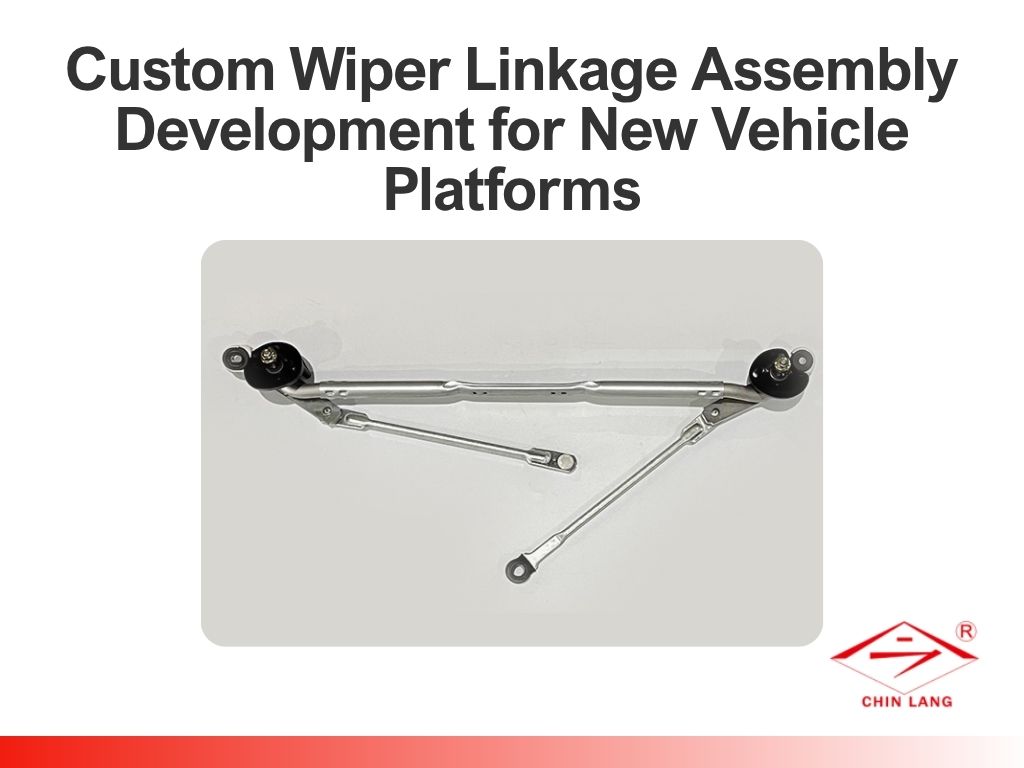
As vehicle platforms continue to evolve, windshield wiper systems must adapt to increasingly complex design requirements. Modern vehicles feature larger windshields, aerodynamic body shapes, advanced driver assistance systems, and more compact engine compartments — all of which directly affect the design of the wiper linkage assembly.
For OEM manufacturers and automotive system suppliers, developing a custom wiper linkage assembly is no longer simply a matter of adapting an existing design. Each new vehicle platform introduces unique geometric, structural, and operational requirements that demand application-specific engineering.
Based on long-term development and manufacturing experience in automotive wiper system components, including ongoing production practice at Chin Lang Autoparts, engineers recognize that successful custom wiper linkage assembly development depends on balancing motion accuracy, durability, packaging constraints, and manufacturing consistency. A properly engineered linkage system improves wiping performance, reduces long-term maintenance concerns, and supports reliable vehicle operation under diverse driving conditions.
Why New Vehicle Platforms Require Custom Wiper Linkage Assemblies
Modern vehicle architecture varies significantly between:
-
Passenger cars
-
SUVs
-
Pickup trucks
-
Commercial vehicles
-
Electric vehicles
Differences in windshield dimensions, hood design, cowl geometry, and motor positioning often make standard linkage assemblies unsuitable.
Custom development allows engineers to optimize:
-
Wiper sweep coverage
-
Arm synchronization
-
Motor load distribution
-
Packaging efficiency
-
Structural durability
Without platform-specific development, wiping performance may suffer from incomplete coverage, vibration, excessive noise, or premature wear.
Key Development Factors in Custom Wiper Linkage Assembly Design
Windshield Geometry and Sweep Area
The size and curvature of the windshield determine:
-
Wiper arm travel angle
-
Sweep boundary limits
-
Required linkage geometry
Engineers must ensure the wiping pattern maximizes visibility while avoiding interference with vehicle trim or A-pillars.
Motor Position and Packaging Constraints
Modern engine compartments are increasingly compact, especially in hybrid and electric vehicle platforms.
Custom linkage development must account for:
-
Available installation space
-
Motor mounting position
-
Hood and cowl clearance
-
Integration with other vehicle systems
Efficient packaging helps reduce assembly complexity while maintaining stable motion performance.
Synchronization and Motion Accuracy
Precise synchronization between wiper arms is essential for:
-
Uniform wiping performance
-
Reduced vibration
-
Stable high-speed operation
-
Proper parking position alignment
Linkage geometry, pivot tolerance, and lever ratios must all be carefully engineered to maintain consistent movement across the entire wiping cycle.
Structural Durability Under Real Driving Conditions
Wiper linkage assemblies experience:
-
Continuous vibration
-
Repeated cycling
-
Wind resistance at high speed
-
Heavy rain and snow loading
Custom-developed systems must withstand these conditions over long service life without excessive wear or loss of synchronization.
Material Selection and Manufacturing Considerations
The durability of a custom wiper linkage assembly depends heavily on material and manufacturing quality.
Important considerations include:
-
Reinforced steel link rods
-
Corrosion-resistant surface treatment
-
Wear-resistant pivot interfaces
-
Consistent dimensional accuracy
-
Stable assembly tolerances
Production consistency is especially important for OEM programs where large production volumes require repeatable quality across batches.
Development Process for Custom Wiper Linkage Assemblies
A typical development process includes:
Application Analysis
Engineers evaluate:
-
Vehicle platform dimensions
-
Windshield sweep requirements
-
Motor specifications
-
Environmental operating conditions
Prototype Development
Initial linkage geometry and motion characteristics are tested using prototype assemblies.
Motion and Durability Testing
Testing may include:
-
Sweep synchronization validation
-
Vibration resistance
-
Continuous cycle durability
-
Corrosion exposure testing
Production Validation
Manufacturing processes are optimized to ensure:
-
Repeatable assembly quality
-
Dimensional consistency
-
Long-term production stability
Passenger Vehicle vs Commercial Vehicle Requirements
| Vehicle Type | Primary Design Focus |
|---|---|
| Passenger Cars | Compact packaging and smooth operation |
| SUVs | Larger sweep coverage |
| Pickup Trucks | Increased vibration resistance |
| Commercial Vehicles | Heavy-duty durability and extended cycle life |
| Electric Vehicles | Space-efficient integration |
Each platform type introduces different engineering priorities during custom development.
Custom Wiper Linkage Assembly Development at Chin Lang Autoparts
Chin Lang Autoparts develops and manufactures custom wiper linkage assemblies for a wide range of automotive applications, supporting both OEM and aftermarket programs. The company’s engineering and production experience allows development teams to adapt linkage configurations to different vehicle platform requirements while maintaining stable wiping performance and long-term durability.
Development priorities include:
-
Application-specific linkage geometry
-
Precise synchronization control
-
Structural rigidity under repeated cycling
-
Corrosion-resistant component design
-
Consistent manufacturing quality
By combining practical manufacturing experience with application-focused engineering, Chin Lang Autoparts supports customers seeking reliable custom wiper linkage assembly solutions for modern vehicle platforms.
FAQ — Custom Wiper Linkage Assembly Development
1. Why can’t all vehicles use the same wiper linkage assembly?
Different windshield sizes, motor locations, and vehicle packaging layouts require application-specific designs.
2. What factors affect wipe synchronization?
Linkage geometry, pivot tolerance, lever ratios, and structural rigidity all influence synchronization accuracy.
3. Do electric vehicles require different linkage designs?
Often yes. EV platforms may have tighter packaging constraints and different motor placement requirements.
4. How important is corrosion resistance in linkage assemblies?
Very important. Corrosion increases friction and may affect long-term synchronization performance.
5. What is the biggest challenge in custom linkage development?
Balancing compact packaging, motion precision, durability, and manufacturing consistency simultaneously.
Partner with a Trusted Wiper Linkage Assembly Development Partner
Developing a reliable wiper linkage assembly for a new vehicle platform requires more than simple dimensional adjustment. Successful systems depend on precise engineering, motion accuracy, durability validation, and stable manufacturing execution.
With extensive automotive component manufacturing experience, Chin Lang Autoparts provides custom wiper linkage assembly development support for passenger vehicles, commercial vehicles, and emerging automotive platforms.
Contact Chin Lang Autoparts to discuss custom wiper linkage assembly specifications, OEM development projects, and long-term supply cooperation opportunities.