
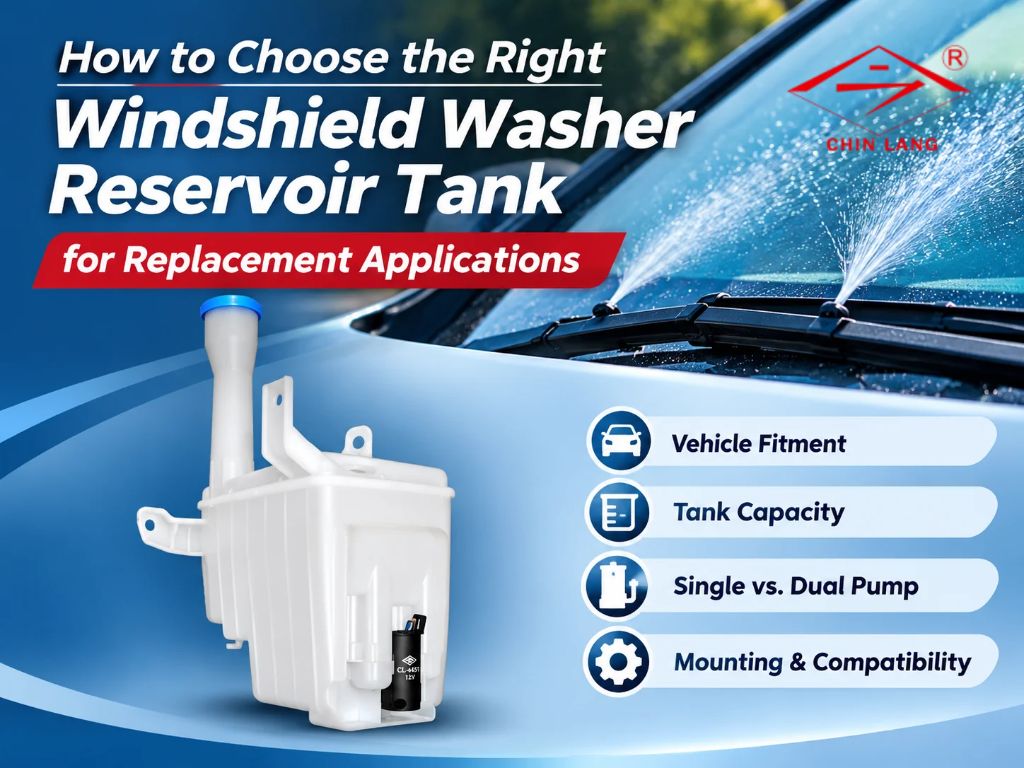
A windshield washer reservoir tank may appear to be a simple fluid storage component, but choosing the wrong replacement can lead to installation problems, fluid leaks, pump incompatibility, or unnecessary rework. For automotive parts distributors, repair professionals, and aftermarket buyers, accurate product selection requires more than matching the tank's appearance.
At Chin Lang Autoparts, we manufacture windshield washer reservoir tanks and related washer system components for automotive applications. This guide explains the key factors buyers should evaluate when selecting a replacement reservoir, from vehicle compatibility and mounting design to pump configuration and electrical requirements.
1. Why Does Washer Reservoir Compatibility Matter?
The windshield washer reservoir stores cleaning fluid and supplies it to the washer pump. Although its function is straightforward, the tank must fit within the available vehicle space and connect correctly to the washer system.
An incompatible reservoir may cause interference with surrounding components, misaligned mounting points, or improper pump and hose connections. These problems can increase installation time and create additional costs for repair businesses.
Key Takeaway: Replacement compatibility should be evaluated as a complete system, not solely by the external shape of the tank.
2. How to Check Vehicle Fitment and Mounting Design
Vehicle make, model, and production year are the starting points for selecting a windshield washer reservoir tank. However, vehicles within the same model generation may have different reservoir configurations depending on equipment and regional specifications.
Buyers should verify the original equipment (OE) reference number where available, then compare the replacement tank's mounting points, filler neck position, pump openings, and hose connections.
For example, Chin Lang offers the CL-6201 Windshield Washer Reservoir Tank, listed for the 2002–2007 Mitsubishi Lancer with OE reference MR570436. This illustrates how model-specific fitment and OE references can support product identification.
Key Takeaway: Matching vehicle applications and OE references helps narrow the selection, but installation details should still be confirmed.
3. What Tank Capacity Is Suitable?
Reservoir capacity determines how much washer fluid the system can store before refilling. When replacing an original tank, maintaining the intended capacity and physical configuration is generally preferable to choosing a larger tank simply for convenience.
Capacity is especially important for universal applications, where buyers may have greater flexibility in selecting a reservoir but must also consider available installation space.
Chin Lang's product range includes universal reservoirs such as the CL-2030, specified as a 1.5L, 12V configuration, and CL-2034, specified as a 3.0L, 24V single-pump configuration.
A larger capacity does not automatically mean better compatibility. Buyers must verify the mounting arrangement, electrical system, and available space before selecting a universal reservoir.
4. Single-Pump vs. Dual-Pump Reservoirs: What's the Difference?
Pump configuration is one of the most important differences between windshield washer reservoir tanks.
A single-pump reservoir is designed for a system using one washer pump. A dual-pump reservoir accommodates two pumps, which may be required for separate washer circuits depending on the vehicle's design.
| Selection Factor | Single-Pump Reservoir | Dual-Pump Reservoir |
|---|---|---|
| Pump configuration | One pump | Two pumps |
| Typical selection basis | One washer circuit | Separate washer circuits |
| Installation check | One pump opening and corresponding connections | Two pump openings and corresponding connections |
| Key compatibility concern | Pump and hose fitment | Both pump positions and connections |
Chin Lang lists both single-pump and dual-pump configurations, including the 12V CL-6451 single-pump reservoir and the 12V CL-6450 dual-pump reservoir.
Buyers should also check whether the replacement product includes the pump, cap, or other required accessories. The presence of these components should not be assumed across all suppliers or product models.
Key Takeaway: Select the reservoir based on the original washer system configuration rather than assuming that single-pump and dual-pump tanks are interchangeable.
5. How to Evaluate Reservoir Materials and Sealing
A replacement washer reservoir must withstand normal operating conditions, washer fluid exposure, and vibration during vehicle use.
When evaluating a product, buyers should pay attention to the condition and design of the tank body, pump mounting openings, fluid connections, and cap interface.
Important considerations include resistance to cracking, secure mounting, proper sealing around pump grommets, and the absence of leakage after installation.
For distributors sourcing aftermarket products, consistent product dimensions and inspection procedures can also help reduce fitment complaints and returns.
Rather than relying on unverified claims about material grades or durability, buyers should request product specifications, inspection information, and application confirmation from the manufacturer.
6. Replacement Reservoir Selection Checklist
Before approving a replacement windshield washer reservoir tank, use the following checklist to review the most important requirements.
| Checkpoint | What Buyers Should Verify | Why It Matters |
|---|---|---|
| Vehicle application | Make, model, year, and relevant vehicle configuration | Reduces incorrect fitment |
| OE reference | Original equipment part number, when available | Supports cross-reference identification |
| Mounting design | Brackets, fixing points, and tank shape | Helps ensure proper installation |
| Tank capacity | Required fluid capacity and available space | Maintains suitable system configuration |
| Pump configuration | Single or dual pump | Matches the washer circuit arrangement |
| Electrical requirements | 12V or 24V, where a pump is supplied | Helps avoid electrical incompatibility |
| Connections | Hose outlets, pump openings, and filler neck | Supports correct system integration |
| Included components | Pump, cap, seals, and other accessories | Clarifies the replacement scope |
For example, Chin Lang's CL-2037 universal reservoir is listed as a 3.0L, 12V, two-pump configuration. Its specifications differ from those of a 24V single-pump reservoir, so the two should not be treated as interchangeable solely because both are universal products.
7. Frequently Asked Questions
Can a universal windshield washer reservoir replace an original vehicle-specific tank?
A universal reservoir may be suitable when its dimensions, mounting arrangement, capacity, pump configuration, and connections match the installation requirements. However, the term universal does not guarantee direct fitment in every vehicle.
Can I replace a dual-pump reservoir with a single-pump reservoir?
Not without verifying the vehicle's washer system requirements. If the original system uses two separate pumps, a single-pump reservoir may not support all intended washer functions.
Does a new washer reservoir always include a pump?
No. The included components vary by product and supplier. Buyers should check whether the replacement assembly includes the pump, cap, seals, or other accessories before ordering.
8. Explore Chin Lang Windshield Washer Reservoir Solutions
Choosing the right windshield washer reservoir tank requires careful attention to vehicle fitment, pump configuration, tank capacity, and installation details.
Chin Lang Autoparts offers vehicle-specific and universal windshield washer reservoir tanks, along with related washer system components. We work with automotive parts buyers seeking suitable replacement products and support for their application requirements.
Explore our reservoir products or contact our team with your vehicle application, OE reference, and required specifications to discuss suitable options.
More Articles
Windshield Washer Pump Not Working? Common Causes and What to Check